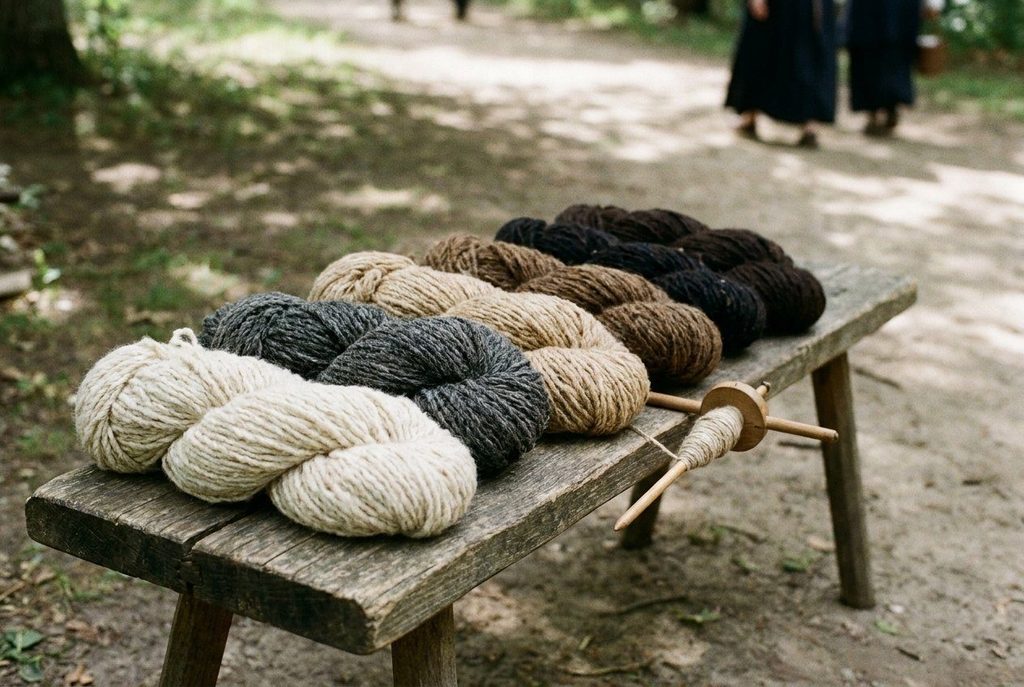
In the foothills of the Chuska Mountains, Navajo weavers make some of the finest rugs in the Southwest without a drop of dye: only the colours the sheep grow.
- Where to see it
- Museums in the region, and fairs and markets across the Navajo Nation
- Look for
- The colours: every shade from cream to near-black comes from the fleece itself, carded together, never from a dye pot.
Drive south from Shiprock on US-491 and the Chuska Mountains rise on your right, dark with pine above a long apron of sage and sand. In the small communities along their foot, around Toadlena and the old crossroads called Two Grey Hills, Navajo weavers developed a style of rug in the early twentieth century that is still counted among the most demanding in the Southwest. It uses no dye at all. Every colour in a Two Grey Hills rug comes from the sheep.
The colours the sheep grow
A Two Grey Hills rug is woven in natural wool: white, black, and the browns and greys between them. Black fleece is rarely a true black, so weavers often deepen it, but the classic palette stays earthy and quiet. The greys and tans are made by carding white and dark wool together before spinning, the way a painter mixes two colours on a palette. A good weaver can card a dozen shades that step evenly from one to the next.
That restraint is the point. Without bright reds to carry the design, the pattern has to work through contrast and precision. Look at the border first: almost always a band of black or dark brown, framing the whole piece like the mount of a print. Inside it, the field usually holds one or two central diamonds, stepped or serrated, with smaller geometric figures packed around them and filling the corners.
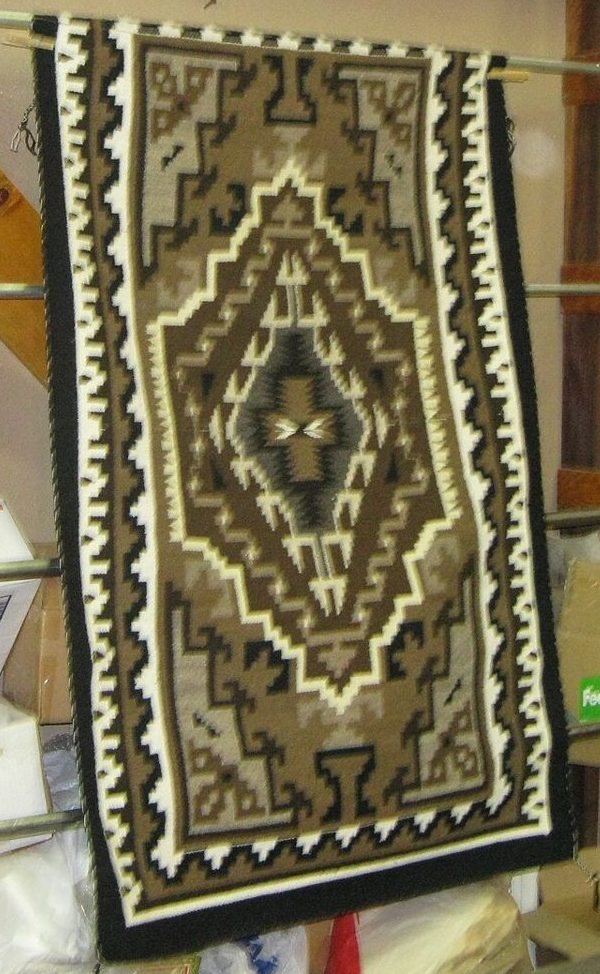
The style grew up in the 1910s and 1920s, when the trading economy of the reservation was pushing weavers away from blankets for their own use and towards rugs for buyers in the cities. Many regions of the Navajo Nation developed a look of their own in those decades. Around Two Grey Hills the answer was fine yarn, tight weaving and the colours of the flock, and it has held for a century. You can trace how the same country shaped other crafts in the story on Navajo silversmithing.
How fine is fine
What collectors talk about most is the count: how many weft threads a weaver packs into an inch. An ordinary rug might have a few dozen. A Two Grey Hills piece of good quality has far more, and the finest, which collectors class as the top grade, go past a hundred wefts to the inch. At that density the surface feels almost like heavy cloth, and the edges of each little triangle are crisp enough to look printed.
Fine yarn is the reason. Wool is spun on a hand spindle, a long wooden shaft with a disc near the bottom, and for the finest work it is spun again and again until it is thin, even and very tight. Spinning can take longer than the weaving itself. A single large rug may stand for months of work spread across shearing, washing, carding, spinning and finally the loom.
Spinning can take longer than the weaving itself.
The upright loom
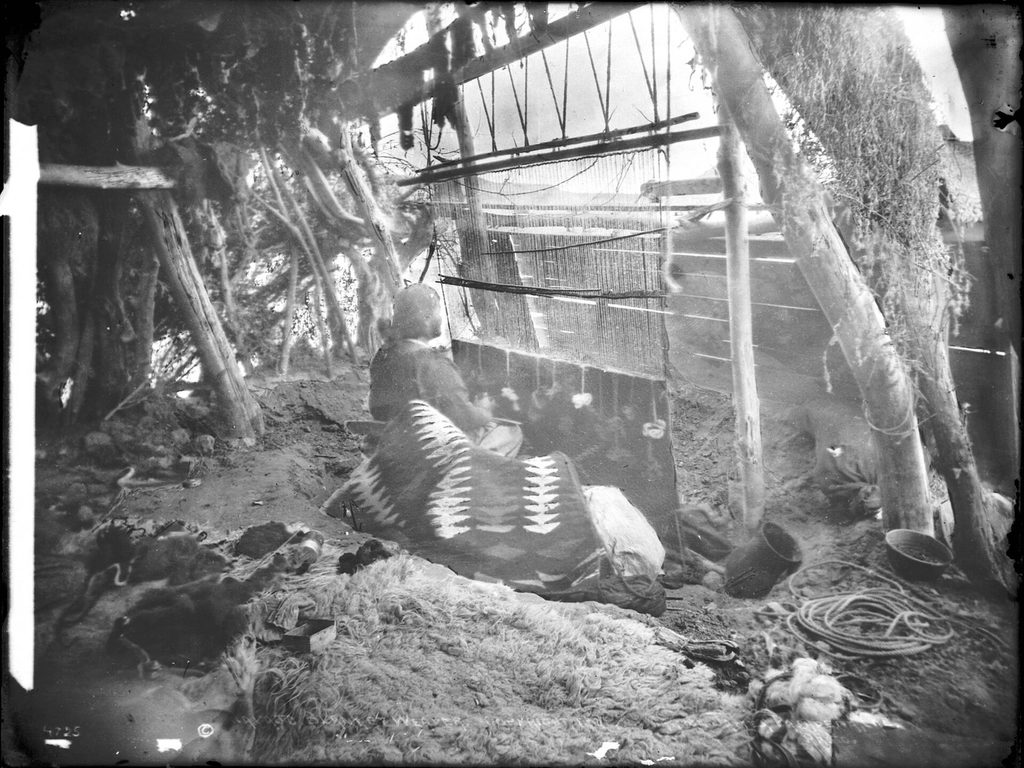
Navajo weaving is done on an upright loom, a frame of two posts and two beams with the warp stretched tight between them. Navajo people learned to weave from their Pueblo neighbours by the 1600s and 1700s, and the sheep arrived with the Spanish: the hardy churro breed, whose long, low-grease wool still suits hand spinning. Navajo tradition tells it differently, giving the loom and the knowledge of weaving to Spider Woman and her teachings. Both stories are honoured in weaving families.
Read alongsideBuying Native-made work without guessingThe weaver sits in front of the loom and works from the bottom up, passing weft yarn through the open shed by hand and beating it down with a wooden comb. Because the loom is upright and the weaver does not roll the finished part away, she raises her seat or lowers the work as the rug grows. Each colour area is woven separately and joined to its neighbour, which is why the back of a Navajo rug looks almost the same as the front.
Some rugs carry a single thin line of contrasting yarn running from the inner field out through the border. It is often called a weaver's pathway or spirit line, and families explain it in their own ways. Not every weaver uses one, and its absence says nothing about quality.
Looking closely at a rug
When you get the chance to look at a Two Grey Hills rug in a museum or at a fair, give it a few minutes and go through it in order.
- The edges. Run your eye down each side. A well-woven rug has straight selvedges with no waisting, the inward curve that appears when the weft is pulled too tight.
- The corners. Navajo rugs finish with tassels or twisted cords at the four corners, part of the edge cords that run around the whole piece.
- The symmetry. Fold the design in your head along both axes. The best pieces mirror almost perfectly, which is planned in the weaver's mind with no drawing on paper.
- The shades. Count the greys and browns. More shades, evenly stepped, means more carding and more care.
- The flatness. Seen from the side, a good rug lies flat with no ripples.
Ask before you touch anything. Collections and makers are generous with people who show interest, but oils from hands do real harm to wool over time.
The country it comes from
The Two Grey Hills area lies on the Navajo Nation in New Mexico, a landscape of open range below the Chuskas with the volcanic neck of Shiprock standing far off to the north. It is home first, not a sight. There is no single place to go and watch weaving, and private homes and grazing land are not stops on a drive. The way to see this work is in the region's museums, at the fairs and markets held across the Navajo Nation, and from the weavers themselves when they sell their own work.
If you are staying in Farmington, the drive down through the foothills makes a good half day, simply for the land. Keep to paved roads in wet weather, carry water, and remember that the Navajo Nation keeps its own laws and its own clock: in summer it observes daylight saving time while the rest of Arizona does not.
Getting there: uS-491 south from Shiprock, then west. Bring: patience, good light and a soft measuring tape. More in made by hand. Pictures are credited on the pictures page.