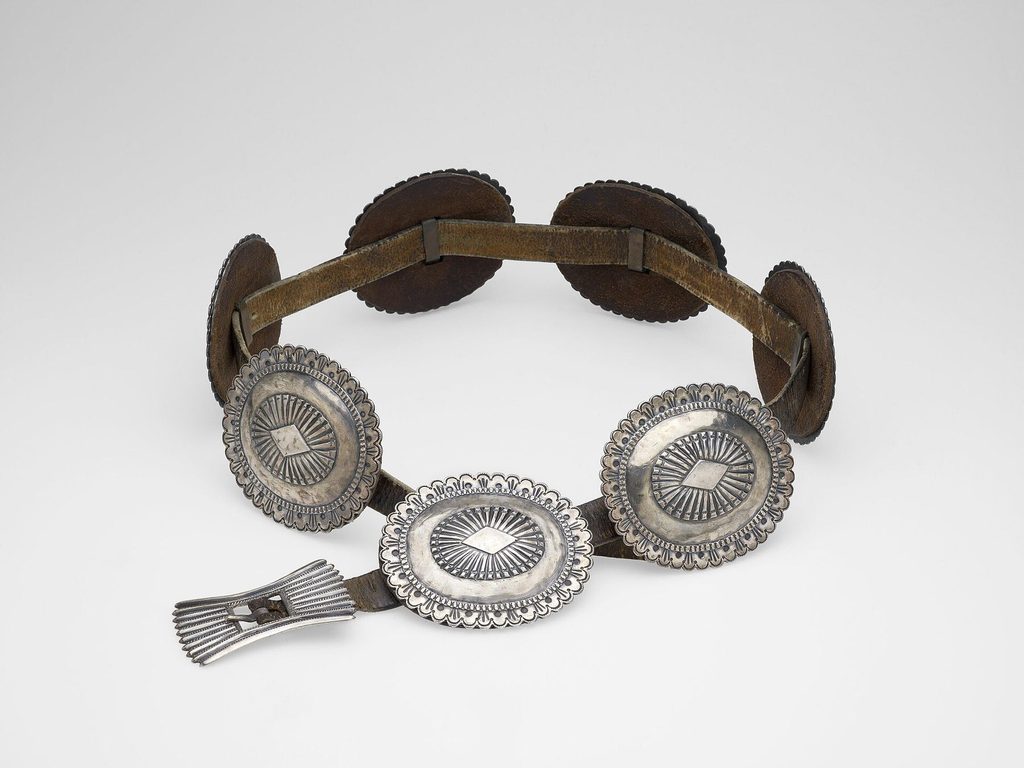
Navajo silverwork is younger than many people think. It began in the middle of the 1800s with a few smiths, coin silver and tools made from scrap iron.
- Where to see it
- Regional museums, and fairs across the Navajo Nation such as the one at Shiprock
- Look for
- The stamp marks: each small repeated shape was struck by hand with a steel punch the smith often made himself.
Silver and turquoise are so closely tied to the Southwest that it is easy to imagine they have always been there. Navajo silversmithing is, in fact, a craft of the last century and a half. Its history is short, well remembered and full of borrowing, which is part of what makes the work so interesting to look at.
The first smiths
Navajo tradition names Atsidi Sani, often translated as Old Smith, as the first Navajo silversmith. He is said to have learned ironwork and then silverwork from a Mexican smith in the 1850s or 1860s, and to have taught his sons and others in turn. The years of the Long Walk and the confinement at Bosque Redondo in the 1860s interrupted everything, but after the return to the homeland in 1868 the craft spread quickly.
The earliest silver came from coins. American dollars and Mexican pesos were melted down, poured into ingots and hammered into shape. Tools were whatever a smith could make: dies cut from scrap iron, punches filed from old files or bolts, a simple forge with a hand bellows. That spare kit still shapes the look of old pieces, with their heavy metal and bold, simple stamping.
Where the forms come from
Many of the most familiar Navajo designs began as something else. The naja, the crescent pendant that hangs at the bottom of a squash blossom necklace, came to the Southwest as an ornament on Spanish horse bridles, which in turn had roots in North Africa. The squash blossom beads themselves, the flared shapes between the round beads, are thought to copy the pomegranate-shaped buttons once worn on Spanish and Mexican clothing. The name was given later.
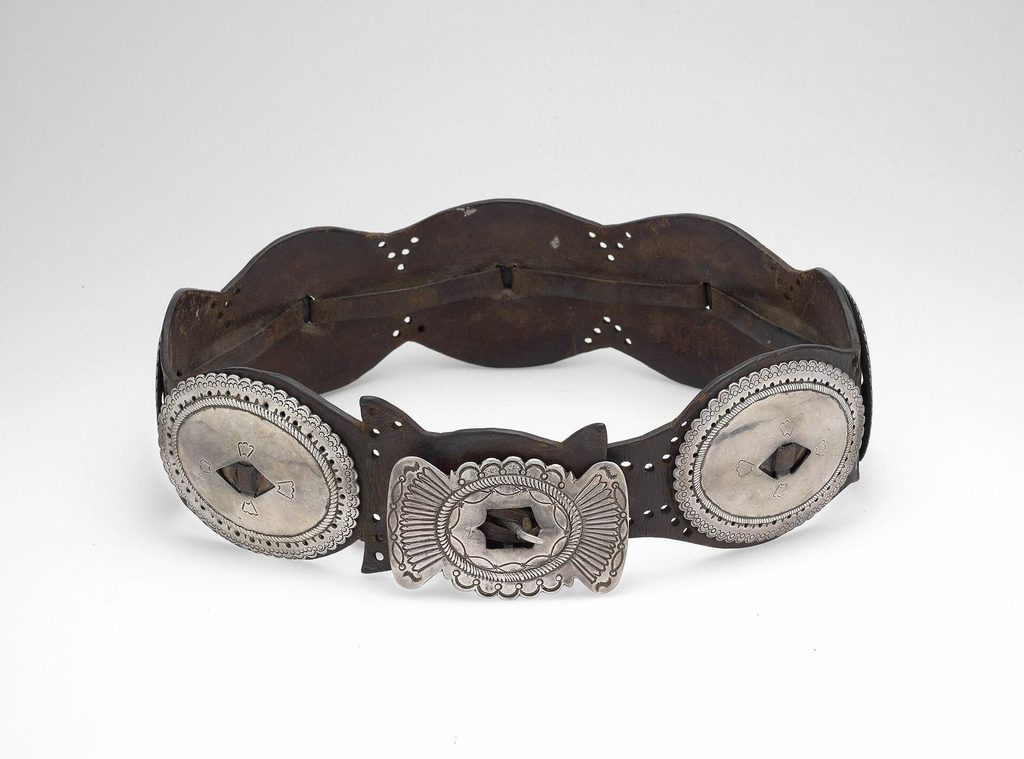
Read alongsideTwo Grey Hills: rugs woven from undyed woolConcho belts, with their row of oval silver plates, are linked to the round hair plates worn by Plains peoples, traded across the region in the 1800s. Bracelets, buttons, buckles and bow guards (the ketoh, a wrist guard first made to protect an archer's arm) filled out the early range.
Turquoise joined silver from the 1880s onwards, as better tools and a growing outside market made setting stones practical. Before that, turquoise had a long life of its own in the region as beads and inlay, worked by Pueblo people for centuries.
Stamping, casting and overlay
Three techniques cover most of what you will see.
- Stamping. The smith strikes a hardened steel punch into the silver, over and over, to build a pattern from a small motif. Look closely at an old piece and you can see that no two strikes are exactly alike.
- Tufa casting. Tufa is a soft volcanic stone. The smith carves a design into a block of it, binds a second block over the top, and pours molten silver into the channel. The stone leaves a slightly grainy surface on the finished piece, and the mould is often good for only a few castings.
- Sand casting. An older method, using moulds of packed sand or stone, gives the heavy, rounded forms of many early bracelets and buckles.
Overlay, where a cut-out silver sheet is soldered onto a plain one and the low parts are darkened, is more closely tied to Hopi smiths, though it is used widely now.
Training your eye on old pieces
The best way to learn is to look at a lot of old work side by side, in a museum case, before looking at anything for sale. The weight of the metal, the depth of the stamping and the way stones are held in their bezels become easier to read once you have seen fifty pieces. Fairs across the Navajo Nation, including the long-running autumn fair at Shiprock, bring together many makers at once. If you want to buy, the notes in buying Native-made work are worth reading first, and the Farmington story covers the towns that make a good base.
Getting there: museums and fairs across the region. Bring: a small magnifier for hallmarks and stamp work. More in made by hand. Pictures are credited on the pictures page.