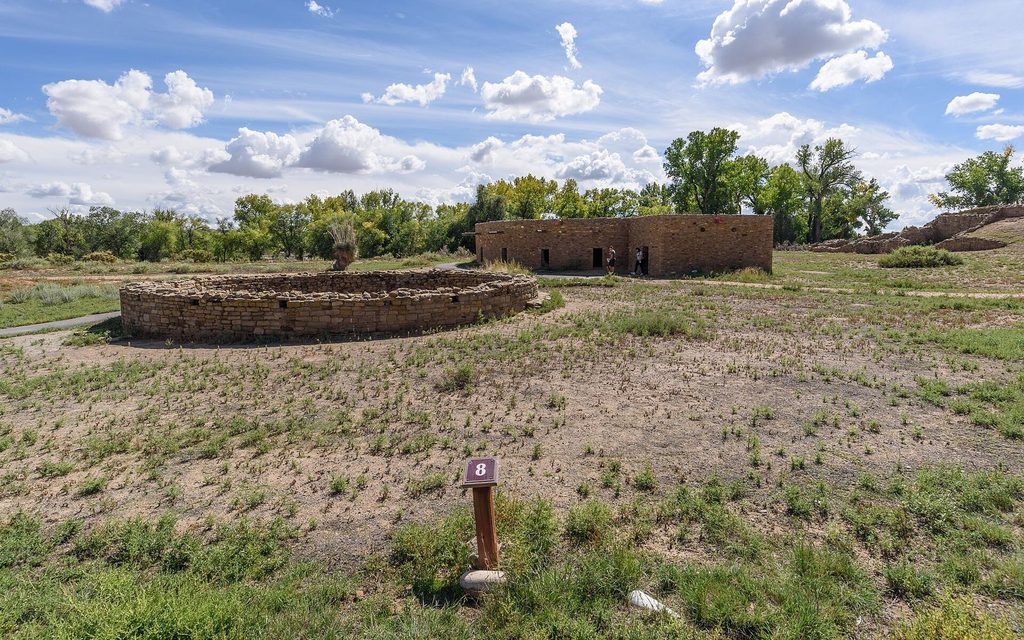
Two great houses on the rivers near Farmington were built in the years around 1100. Their potters left behind the clearest record of who lived there and when.
- Where to see it
- Aztec Ruins National Monument and the museum at Salmon Ruins
- Look for
- The painted lines on black-on-white bowls: fine hatching inside bold outlines, done with a brush of chewed yucca leaf.
Long before Farmington had its name, the river valleys around it were farmed by ancestral Puebloan people, the ancestors of today's Pueblo nations. In the late 1000s and early 1100s they built large, planned stone buildings here, tied by roads and trade to the great houses of Chaco Canyon to the south. Two of them can be visited within half an hour of town: Aztec Ruins on the Animas River and Salmon Ruins on the San Juan. Both are good places to understand how much a broken pot can say.
Aztec Ruins
The name is a mistake. American settlers in the 1800s assumed the walls were built by the Aztecs of Mexico, and the name stuck to the ruins and then to the town beside them. The builders were ancestral Puebloans, and most of the West Ruin, the largest building, went up in a few decades in the early 1100s. It held hundreds of rooms over several storeys. Some still have their original wooden roof beams, and tree-ring dating of those beams is how the building years are known so precisely.
The site's best-known feature is the Great Kiva, a large round ceremonial room. It was rebuilt in the 1930s on its original foundations, and standing inside it is the nearest you can come to the scale and quiet of these spaces. Aztec Ruins is a national monument and part of the Chaco Culture World Heritage Site, listed with Chaco Canyon and other related places.
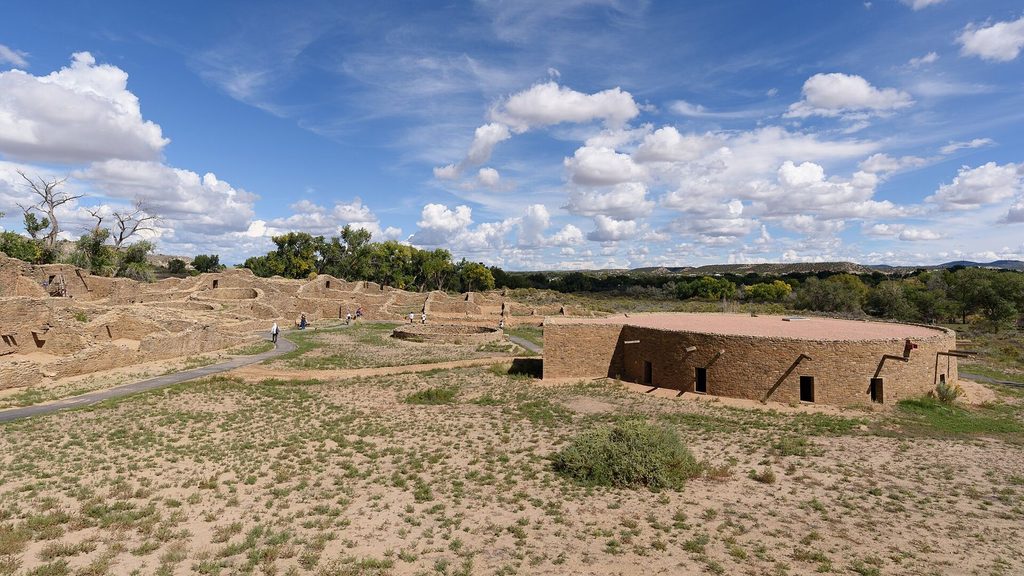
A short trail leads through the West Ruin, ducking through low doorways and past rooms where walls are banded with rows of green stone. The visitor centre shows pottery, tools and textiles found here.
Read alongsideShiprock and the Bisti: the land the painters keep coming back toSalmon Ruins
Salmon Ruins, near Bloomfield, is a Chacoan great house built around 1090, a little before the West Ruin at Aztec. It is named after a homesteading family who protected the site in the late 1800s and early 1900s. Like Aztec, it was lived in a second time, in the 1200s, by people whose pottery and building habits looked north towards Mesa Verde rather than south to Chaco. A fire late in that second occupation sealed many rooms, preserving what was inside.
The site has a museum with a large collection from the excavations, and a heritage park with reconstructed dwellings from different periods of the region's history, from pit houses to a Navajo hogan.
Reading the pottery
Most of what you see in the cases falls into two families.
- Corrugated grey ware. These were the cooking and storage pots. The potter built the vessel with coils of clay and pinched each coil as she went, leaving a texture like basketwork on the outside. It gave a better grip and spread heat over the fire. You will often see soot on the outside.
- Black-on-white ware. Bowls, mugs, pitchers and jars with a white slip and designs in black. Chacoan potters often painted with a mineral paint, and later Mesa Verde style potters favoured a plant-based paint; the two look different under good light, the mineral paint a little browner and the plant paint softer and greyer.
Look for the patterns: spirals, stepped frets, interlocking triangles and fine parallel hatching held inside bold outlines. Brushes were made from yucca leaf, chewed to fibres at the tip. The steadiness of those lines, on curved surfaces, done freehand, is the best measure of the potter's skill. Archaeologists use exactly these differences of paint, clay and design to date rooms and trace who lived where, which is how the story of the two occupations was worked out.
A few things to keep in mind
Both sites protect a record that cannot be replaced. Stay on the trails, do not lean on or climb walls, and leave every sherd where it lies: collecting from any archaeological site is illegal on public land and it removes the evidence that tells the story. Pueblo people today regard these places as homes of their ancestors, so a quiet manner fits.
The two sites pair easily with a morning in Farmington. For the living tradition of handmade work in the region, see the stories on Two Grey Hills weaving and Navajo silver.
Getting there: uS-550 to Aztec; US-64 to Bloomfield. Bring: water, a hat and time for the great kiva. More in the country around it. Pictures are credited on the pictures page.